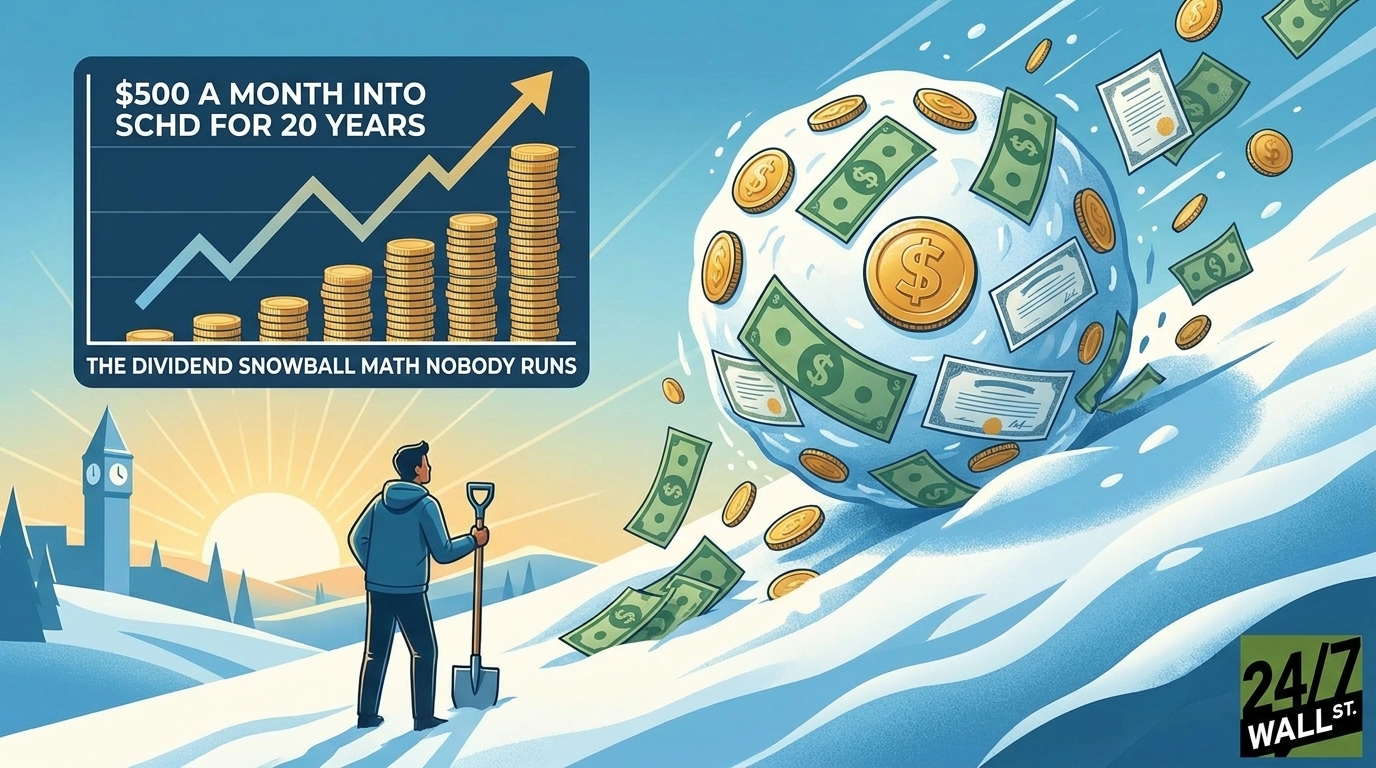
For many investors, the road to financial independence feels like a slow crawl where progress is barely visible for years. This psychological hurdle is precisely why many give up on dividend investing before they hit the tipping point. However, when looking at the mechanics of the Schwab US Dividend Equity ETF, known as SCHD, there is a mathematical phenomenon called the dividend snowball that transforms a modest habit into a powerhouse of wealth. For someone consistently depositing 500 dollars a month, the first decade often feels unremarkable, but somewhere between year twelve and fifteen, something shocking happens: the dividends generated by the account begin to purchase more new shares annually than the investor’s own out-of-pocket contributions.
At its core, SCHD acts as a filter for quality, tracking an index of 100 companies characterized by strong cash flows and a disciplined history of paying shareholders. While it lacks the explosive growth associated with AI and mega-cap tech stocks found in the S&P 500, it offers a steadier path focused on income. Because these companies tend to increase their payouts over time, an investor benefits from yield on cost. This means that while a share might start with a three percent yield today, twenty years of consistent dividend hikes applied to shares bought at lower historical prices can push that effective yield much higher.
The tradeoff for this stability is what some call the patience tax. In recent years, SCHD has trailed broader indices during tech-led bull markets because its screening process intentionally ignores non-dividend payers. An investor solely focused on maximum capital appreciation would likely find more success with a total market fund. Yet for those prioritizing future income, SCHD serves as an ideal anchor in a diversified portfolio, providing a smoother ride and predictable cash flow that eventually takes over the heavy lifting of wealth accumulation.
Ultimately, the magic of the snowball depends entirely on discipline. Historical data shows that an initial investment paired with steady monthly additions could turn into hundreds of thousands of dollars over time through reinvestment alone. The danger lies in stopping too soon; since compounding accelerates exponentially rather than linearly, those who quit in year five miss the crossover point where the machine begins to fuel itself. The strategy proves that while you must spend years shoveling snow manually, if you persist long enough, you eventually create an avalanche of passive income that rolls forward regardless of your further contributions.